Introduction
So for my non-western style art I decided to go with Japanese art more specifically woodblock printing art. Wood block printing was a technique used for centuries in japan it became popular in art for japan around the 17th century with ukiyo-e artist. Now to answer the question of, what is wood block printing, well to explain it simply its basically taking a wooden carving with ink on it and putting a piece of paper on top of it and pressing the paper down on it to copy the wooden engravings and then using other carvings to add pigment and other shapes to the painting. It’s actually kind of cool to see would recommend looking it up to see how it’s done.

The Great Wave off Kanagawa by Katsushika Hokusai
To start off I have the most famous Wood printed piece “The Great Wave off Kanagawa” , an iconic piece that was made around 1830 by Hokusai. This is a great piece that shows off man vs the raging sea. You can see the men crouching down clinging to the boat as they approach the giant wave before them, unable to do anything more then face the wave head on. It’s a cool piece with the wave looking like a massive force only made larger when by this perspective has mount Fuji in the background looking small by comparison. I also can’t imagine how long this took with the different shades of blue and other pigments having to be added in with a different block each time. I also can’t deny this is the piece that came to mind when I thought of non-western art and decided this had to be the first piece I talked about.
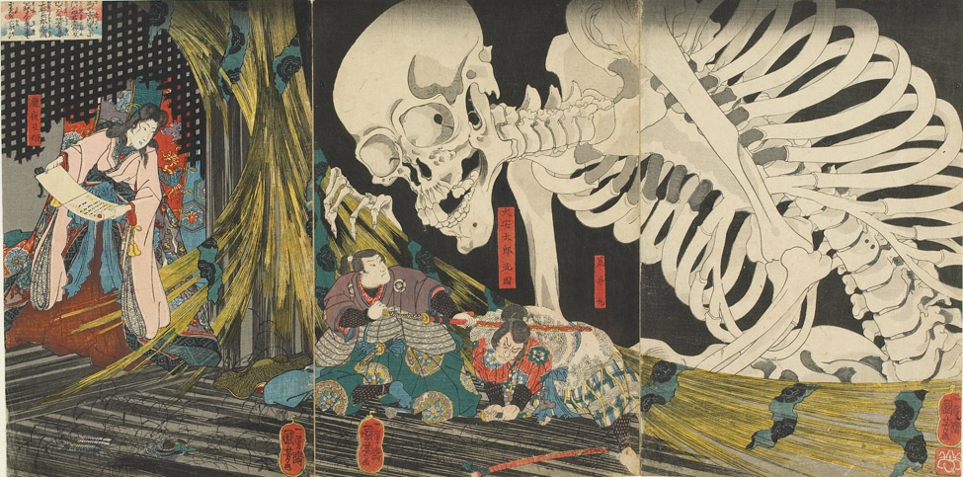
image found at-https://www.vam.ac.uk/articles/japanese-woodblock-prints-ukiyo-e
Takiyasha the Witch and the Skeleton Spectre by Utagawa Kuniyoshi
I love this piece partially cause I just some spooky scary skeletons. This piece comes from Kuniyoshi who loved to make his own depictions of mythical legends. He made Takiyasha the Witch and the Skeleton Spectre in the mid 1840’s as a depiction of a princess who turned to the dark arts in seek of revenge of those who murdered her father. The story follows Princess Takiyasha who’s father was killed during a rebellion and escapes and meets a hermit who teaches her magic which is shown with her holding a scroll which she is reading to summon the giant skeleton. The other bit of the story is the two samurai there who look to be cowering below the skeleton, these two are samurai sent by the emperor to slay the witch and stop her dark arts. I love this piece especially when you know how long these wood prints have to take especially when there are this many different pigments and patterns that need to be individually added to get such a detailed and colorful piece. Also yes, I love this piece cause it has a giant monster and I think giant monster are awesome.

image found at-https://www.invaluable.com/blog/japanese-woodblock-prints/
View of The Lake at Hakone by Utagawa Hiroshige
For my last piece we move from terrifying waves and spooky skeleton to a peaceful and and scenic piece know as “View of The Lake at Hakone”. It’s a piece made around 1833 or 1834 by Utagawa Hiroshige known for making beautiful landscape paintings using the woodblock printing style. I like this piece because of both the beautiful landscape look of the piece as well as the use of blues, oranges and tan white color. It gives it a for lack of a better reference a quilt like color pattern that I don’t see used that often. I think it’s kinda cool to see these blue and orange mountains instead of white and brown or green mountains as they are often painted.
Conclusion
I choose this particular country and art style since I have a love for Japan and their interesting, creative and sometimes strange ideas and this art style just because it was such a unique Idea on how to make a painting and wanted to tall a bit about it. I think Wood block printing art has such a cool and unique look to it and mixed with some of the creative imagination that comes from Japanese culture it would be a fun topic to look into. I hope you enjoyed these painting I showed for this final blog post.
 Vince's art blog
Wowzers! I’m really glad you chose to do this because I also love “The Great Wave off Kanagawa” but I never knew how it was created. Knowing that they had to create layer upon layer of blue pigments makes the creation of this piece that much more incredible. I never thought of it but having Mt. Fuji being portrayed as small makes the wave enormous and I’m really glad you pointed that out! I also enjoy giant monsters and think that Kuniyoshi did a crazy job of making the skeleton scary. I can’t imagine being that samurai. Thanks for choosing Japanese art as your final topic, I think it is really cool and shows what a diverse and cool culture they have.
LikeLike